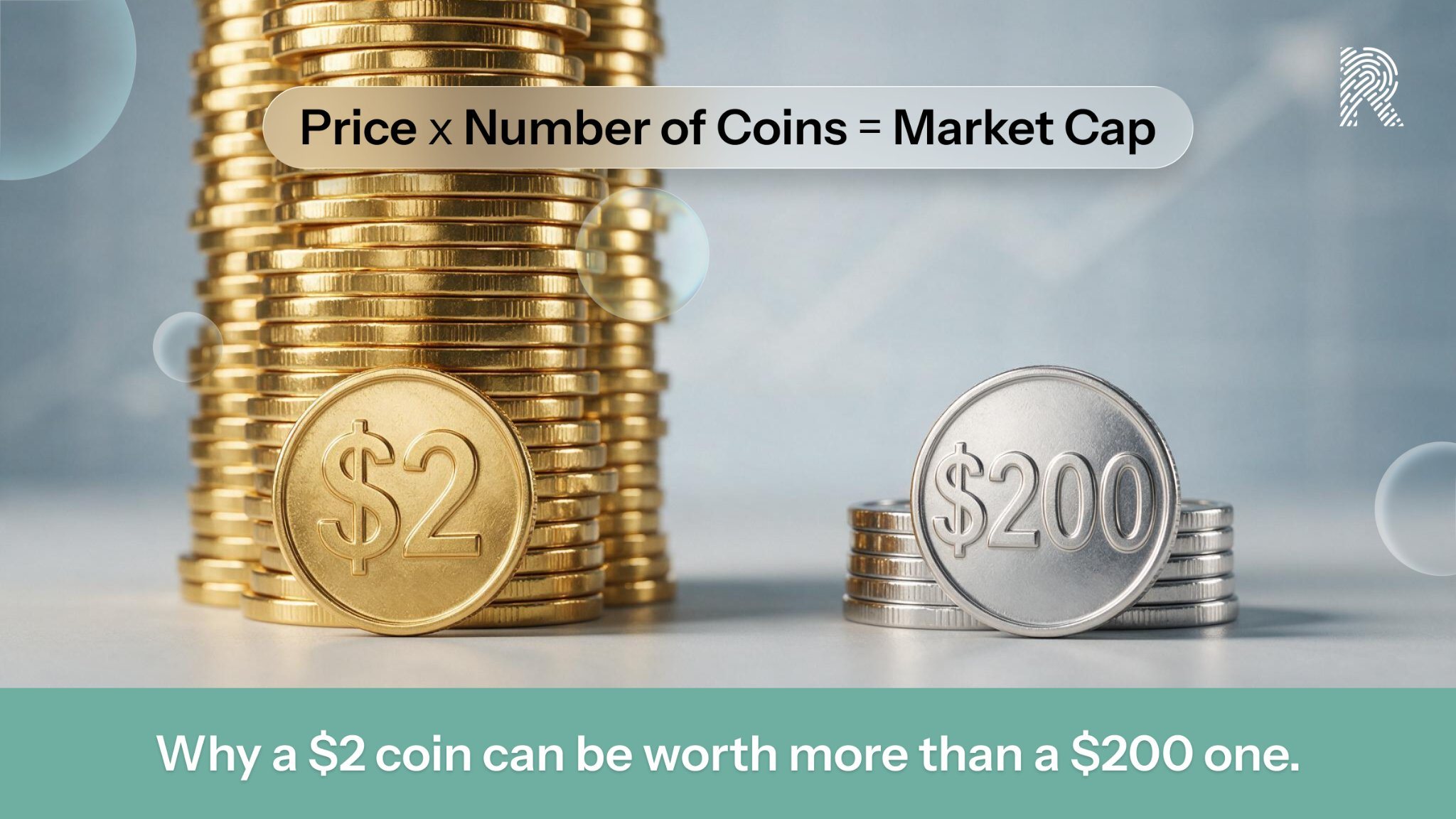
Confused about why a ten-cent coin isn't automatically "cheaper" than Bitcoin? Learn what market cap in crypto actually means, how to calculate it, and how to use it to size up any coin before you Buy, Sell, or Swap.
You're comparing two coins. One costs ten cents, the other costs $79,000. You want to invest in only one of the two. As a beginner, you might think the ten-cent coin is the better deal as it has more room to grow, right? This is the most common trap for anyone new to crypto, and it comes from looking at price instead of market cap.
So what is market cap in crypto? It's the total value of a cryptocurrency, and it's a far more honest number than the price tag on one coin.
In this guide, you'll learn the formula behind it, walk through a real example, and see why checking market cap before you Buy, Sell, or Swap tells you more than watching the price ticker ever will.
What Is Market Cap in Crypto?
Market cap, short for market capitalization, is the total dollar value of every coin currently in circulation. It answers one basic question: how big is this thing, really?
You get it with a simple calculation: price multiplied by how many coins are actually out there. CoinMarketCap defines it the same way, and it's the number crypto data sites rank coins by, not price. That ranking matters, because price on its own tells you almost nothing about the size of a project.
Here's the part beginners miss: two coins can trade at wildly different prices and still represent projects of similar size, or similar prices and represent projects worlds apart in size. Market cap is what actually separates them.
How to Calculate Market Cap in Crypto (Formula and Example)
The Formula
Market cap = Price × Circulating Supply.
Circulating Supply is the total number of coins in circulation.
Think of a lemonade stand. You sell each cup for $1, and you've poured 500 of them today, so your stand made $500. Your day big or small is decided by that final number ($500 in this case) not the $1 price for each cup.
Market cap works the same way for a cryptocurrency: instead of cups sold, you're counting every coin currently in circulation.
A Real Example
As of late August 2026, Bitcoin trades around $79,000, with roughly 19.9 million coins in circulation.
Market cap = $79,000 x 19.9 million = $1.57 trillion
Now picture a smaller coin priced at just $0.05 and 100 billion tokens in circulation. That coin's market cap comes out to $5 billion. It costs pennies, but it's still a mid-sized project by the number that actually counts ie Market Cap.
Why a Low Price Doesn't Mean a Coin Is Cheap
This is where most beginners get confused, and that's precisely why we created this guide.
Cutting a pizza into 16 slices instead of 8 doesn't make the pizza bigger. It just makes each slice cost less. A coin with a massive supply works the same way: more slices, smaller price per slice, same size pizza, or sometimes a much bigger one.
So a coin priced at $0.05 with 100 billion tokens ($5 billion market cap) is actually a larger project than one priced at $50 with only 10 million tokens ($500 million market cap). Remember, the higher price tag is just a number. Market cap is the real thing!
Market cap matters more than price because price only tells you the size of one slice. Market cap tells you the size of the whole pizza. That's the number that reflects what the entire project is worth as per the market, and it's the one worth checking before you decide a coin looks "cheap."
Circulating Supply vs. Total Supply vs. Max Supply
Market cap is only as accurate as the supply number behind it, so it helps to know the three versions you'll run into.
Circulating Supply
The coins actually available and moving through the market right now. This is the number used in the standard market cap formula.
Total Supply
Every coin created so far, including any that are locked up, reserved for the team, or not yet released into circulation.
Max Supply
The hard ceiling, if a project has set one. Bitcoin's max supply is fixed at 21 million coins, hardcoded into the network from the start. Not every project reports these three numbers the same way, so it's worth checking more than one figure before assuming you know a coin's true size.
Market Cap Categories: Large-Cap, Mid-Cap, and Small-Cap Crypto
Once you're comfortable with the math, market cap gives you a quick way to size up any coin you come across.
Category
Typical Market Cap
What It Usually Means
Large-cap
Above $10 billion
Established, widely held, generally the least volatile tier
Mid-cap
$1 billion to $10 billion
Growing projects with real usage, but more price swings than large-caps
Small-cap
Under $1 billion
Early-stage or niche projects, typically the most volatile tier
Bitcoin and Ethereum sit firmly in the large-cap tier. That doesn't make either one immune to price swings, but it does mean a much larger amount of value would need to move for the price to shift as sharply as it can for a small-cap coin.
What Market Cap Tells You (and What It Doesn't)
Market cap is genuinely useful for comparing the overall size of two projects at a glance. What it won't tell you is everything else you'd want to know before deciding what belongs in your Portfolio.
It doesn't measure liquidity, meaning how easily you can actually buy or sell at the price you see. It doesn't account for trading volume, so a coin can carry a large market cap while barely anyone is buying or selling it that day. And it says nothing about whether the project behind the coin is actually being built, maintained, or used.
There's also a quieter issue: circulating supply numbers aren't always reported consistently, and a market cap can look bigger or smaller depending on how a project counts its own supply. The SEC's investor resources on crypto assets are worth a look if you want a fuller picture of the risks involved before putting money into any crypto asset. None of this is investment advice, just context worth having before you rely on one number to make a decision.
How to Use Market Cap When Evaluating Your Portfolio
The practical habit is simple: check market cap alongside price, not instead of it, before you Buy, Sell, or Swap.
If you're weighing two coins and one has a much lower price, don't stop there. Pull up the market cap on both. You might find the "cheaper" one is actually the larger project, or that it's a small-cap coin carrying more risk than its price tag suggests.
RockWallet shows this directly in your Portfolio, so you're never guessing at a coin's real size before you act. If you're new to buying your first coin, our guide on how to buy Bitcoin safely walks through the basics.
Ready to see it for yourself? Download the RockWallet app and set up your account to Buy, Sell, or Swap crypto with a clearer view of what you actually hold.
Where to Check Crypto Market Cap in Real Time
Market cap changes constantly, right alongside price, so it's worth checking fresh rather than relying on a number from last week.
Inside the latest RockWallet app, you can see a coin's current market cap right where you'd check its price, before you Buy, Sell, or Swap. If you want to see a picture of the whole market general crypto data websites, CoinMarketCap or CoinGecko keep updating market cap numbers all the time as prices change. Either way, the habit matters more than the source: check market cap, not just price, every time you're sizing up a coin.
If you haven't compared how different coins stack up yet, our guide on Bitcoin versus altcoins is a good next read.
To Sumarize
Market cap is the number that actually tells you how big a cryptocurrency is, not the price you see first. Once you're comparing price and market cap together, "cheap" stops meaning "small supply" and starts meaning something you can actually evaluate.
Check it for yourself the next time you're sizing up a coin. Set up your RockWallet account and see market cap right alongside price before you Buy, Sell, or Swap.
FAQ
Is a higher market cap always better?
Not necessarily. A higher market cap usually means a larger, more established project with more people holding it, but "better" depends on what you're looking for. Large-cap coins tend to be steadier, while smaller-cap coins carry more risk and more potential for sharp moves in either direction.
What counts as a good market cap for a cryptocurrency?
There's no single "good" number. Large-cap (above $10 billion), mid-cap ($1 billion to $10 billion), and small-cap (under $1 billion) each serve different purposes for different people, and the right fit depends on how much risk you're comfortable with.
Does market cap include lost coins?
Usually not accurately. Coins sent to lost wallets or burned addresses are technically still counted as circulating supply unless a project actively tracks and excludes them, which means some market cap figures overstate the coins that are actually accessible or in play.
Can market cap be manipulated?
To some degree, yes. A project can inflate its reported circulating supply, or a small number of large holders can move price sharply on low trading volume, which shifts market cap without reflecting genuine demand. The FTC's guidance on cryptocurrency scams is a useful read if you want to recognize the warning signs of a project overstating its own numbers.
What's the difference between market cap and trading volume?
Market cap is the total value of every coin in circulation. Trading volume is how much of that coin actually changed hands in a given period, usually 24 hours. A coin can have a large market cap and low volume, which often signals it's harder to buy or sell without affecting the price.
Why do two coins with the same price have different market caps?
Because price alone doesn't account for supply. A coin priced at $1 with 10 million in circulation has a $10 million market cap, while another coin also priced at $1 with 10 billion in circulation has a $10 billion market cap. Same price, thousandfold difference in size.
Aalind makes crypto, Web3, & DeFi easy to understand for newcomers, skipping the jargon & explaining things clearly. He's grown 30k+ followers & 6M+ views, & studied 100+ crypto projects. His writing is for education only, not financial advice.